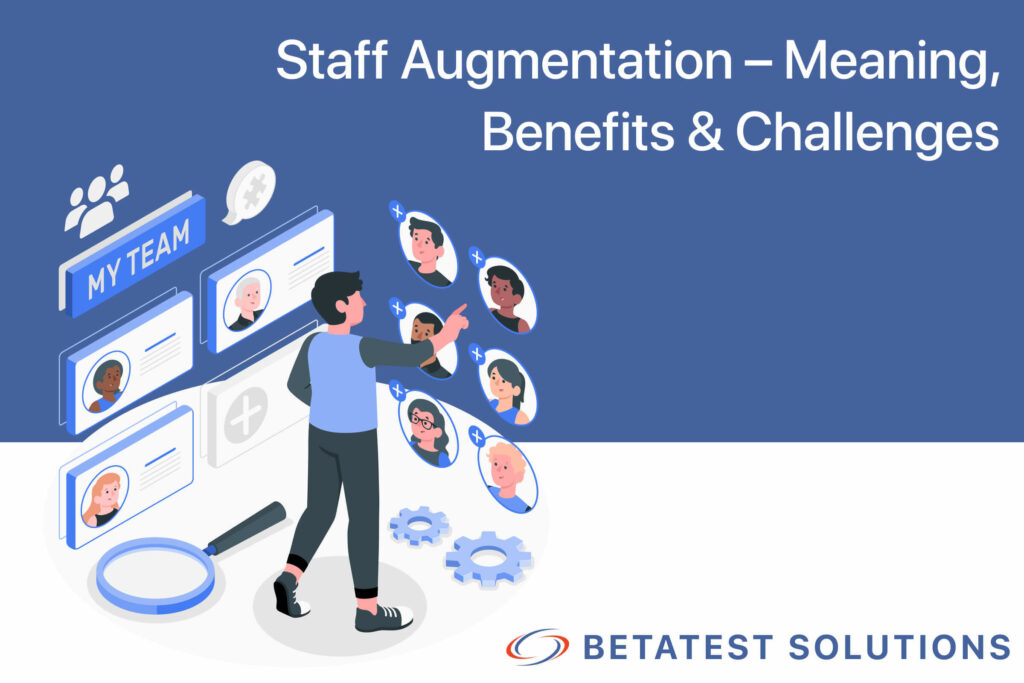
Staff Augmentation Meaning, Benefits & How It Works: Complete 2026 Guide
Introduction
The global IT staff augmentation market is projected to reach $81.87 billion by 2026, with businesses worldwide spending over $1.1 trillion on outsourcing combined. Meanwhile, IDC predicts that over 90% of organisations worldwide will be affected by the IT skills crisis by 2026 — and the average time to fill a specialised technical role is 88 days. For companies running quarterly product cycles, that is not a hiring delay — it is a strategic liability.
In today’s fast-moving technology landscape, the traditional model of hiring full-time employees for every skill gap is too slow, too expensive, and too rigid. Staff augmentation offers a smarter alternative: bring in the exact expertise you need, when you need it, without long-term commitment.
This guide covers everything — the staff augmentation meaning, how it works, the types available, pros and cons, how it compares to outsourcing, and how to choose the right partner for your business. Betatest Solutions is consistently recognised among the top software development companies in India for its end-to-end staff augmentation expertise.
What Is Staff Augmentation? Meaning and Definition
In simple terms, the staff augmentation meaning refers to temporarily adding external professionals to your existing team — while you retain full control of management, processes, and project direction. Unlike traditional hiring, augmented professionals work under your direct supervision, filling specific skill gaps or meeting project demands without the overhead of permanent employment.
In practice, this means a company can bring in a React developer for a six-month product build, a cybersecurity specialist for a compliance project, or a team of QA engineers for a major release — and release them when the need is met.
Key characteristics:
- Temporary and project-driven — not a permanent hire
- Skills-based selection — professionals matched to specific technical needs
- Company retains full control — augmented staff work within your processes and reporting structure
- Scalable — team size adjusts up or down based on demand
- Cost-efficient — no long-term salary commitments, benefits, or training costs
Staff Augmentation Meaning in Software Development
In software development specifically, IT staff augmentation addresses three core problems:
Filling skill gaps — When a project requires expertise in a specific framework, programming language, or technology that the internal team does not have, augmented staff bring that capability without requiring the company to hire and train a full-time employee.
Meeting tight deadlines — Adding experienced developers to a project at a critical stage allows teams to deliver on time without burning out existing staff.
Managing workload peaks — Software projects frequently fluctuate in intensity. Technology staff augmentation allows teams to scale up during high-demand phases and scale down once requirements stabilise.
Historical Evolution of Staff Augmentation
From Traditional Hiring to Modern Staff Augmentation
Permanent employment once occupied every role in the workforce. Companies hired for stability, built large internal teams, and rarely looked outside for specific technical skills. This model worked when change was slow and technology requirements were predictable.
The rise of contract work, digital transformation, and rapidly evolving technology stacks changed everything. Organisations found themselves needing skills that simply did not exist internally — and needing them fast. Technology staff augmentation emerged as a response: a structured way to access specialist talent without the friction of traditional recruitment.
The Impact of Remote Work and the Gig Economy
The shift to remote work — accelerated by the COVID-19 pandemic — proved that distributed teams could collaborate effectively regardless of geography, expanding the talent pool from local to global.
Simultaneously, the rise of the gig economy created a growing pool of skilled professionals who actively prefer flexible, project-based work. Today, experienced engineers, data scientists, and security specialists choose contract engagement over full-time employment. Staff augmentation sits at the intersection of these two trends, giving businesses access to this global, flexible workforce through a structured, managed model.
Types of Staff Augmentation
By Skill Level
| Type | Description | Best For |
| Commodity | General support roles — manual or administrative tasks | High-volume, lower-skill operational needs |
| Skill-based | Specialists in defined areas — programming, design, QA | Project-specific technical requirements |
| Highly-skilled | Deep experts — AI, cybersecurity, cloud architecture, blockchain | Complex, high-stakes technical challenges |
By Duration
Short-term augmentation — Ideal for urgent assignments, covering absent team members, or filling a gap during a critical delivery window. Typically weeks to a few months.
Long-term augmentation — Extended engagements where specialised talent is needed for prolonged periods. Common in multi-phase enterprise projects.
Project-based augmentation — Tied to a specific initiative with a defined start and end date, requiring unique expertise that is not needed permanently.
By Engagement Model
Traditional staff augmentation — External professionals work on-site alongside the internal team for the duration of the project.
Offshore staff augmentation — Professionals from different countries work remotely. More cost-efficient but requires careful management of time zone differences and communication.
Remote staff augmentation — Professionals work from their own location, providing flexibility without requiring physical presence. Increasingly common post-pandemic.
Agile staff augmentation — Teams are structured to support sprint-based delivery, adapting quickly to changing requirements and priorities within Agile workflows.
When to Consider Staff Augmentation
Staff augmentation is the right choice in these specific situations:
- During busy seasons or workload peaks — scale capacity without over-hiring permanently
- For specialist project requirements — skills not available in-house such as AI, cloud, or cybersecurity
- To meet tight deadlines — augmented professionals contribute immediately without a long ramp-up
- For projects with defined scope — clear start and end dates make augmentation more efficient than permanent hiring
- When internal teams are overloaded — handle overflow without burning out core staff
Industries Using Staff Augmentation
Information Technology — IT companies augment software development, data engineering, DevOps, cloud architecture, and cybersecurity. The pace of technology change means skill gaps emerge faster than traditional hiring can address them.
Finance and Banking — Financial institutions bring in specialists for risk management, regulatory compliance, financial data analysis, and fintech development — areas where niche expertise is essential but not needed full-time.
Healthcare — Healthcare organisations use staff augmentation for medical coding, clinical systems support, EHR implementation, and IT infrastructure — particularly during system upgrades, regulatory changes, or patient-care emergencies that require rapid scaling.
Manufacturing — Manufacturers frequently need extra technical and operational workers during large production orders or peak seasons. Staff augmentation fills these gaps without the long-term overhead of permanent headcount additions.
E-commerce and Retail — Seasonal traffic spikes, platform migrations, and new feature launches drive demand for flexible technical capacity that scales with business cycles.
How Staff Augmentation Works: Step by Step

Step 1 — Identify needs Define exactly what skills are required, for how long, and at what level of seniority. This clarity directly determines the quality of the match.
Step 2 — Find talent Work with a staff augmentation partner who maintains a vetted pool of professionals screened for technical skills, communication ability, and availability.
Step 3 — Selection process Shortlisted candidates go through interviews and technical assessments. The company evaluates not just skills but also cultural fit and communication style.
Step 4 — Onboarding Selected professionals are introduced to the project, team, tools, and processes. Clear onboarding reduces ramp-up time significantly.
Step 5 — Project execution Augmented staff work alongside the internal team, contributing their expertise within the company’s existing workflows and reporting structure.
Step 6 — Performance assessment Regular evaluations and feedback sessions ensure quality standards are maintained. Adjustments can be made if expectations are not being met.
Step 7 — Project conclusion When the engagement ends, augmented staff transition out. The company retains full control of all output, code, and deliverables.
Staff Augmentation vs Outsourcing: Key Differences Explained
The most common confusion in the market is between staff augmentation and outsourcing. While both involve bringing in external talent, they are fundamentally different models — and choosing the wrong one has real consequences.
The core distinction is control. In staff augmentation, external professionals join your team, work in your tools, follow your processes, attend your standups, and report to your managers. You own the roadmap, the architecture decisions, and the final output. In outsourcing, you hand a project or function to a vendor who manages it independently — you set the requirements and review the outcome, but the day-to-day execution belongs to them.
Staff augmentation is the right choice when you already have product leadership and want to stay close to execution. Outsourcing is the right choice when you want to hand off a clearly defined deliverable and not manage the process yourself.
A third option — managed services — goes even further, handing over an entire ongoing business function such as IT support or cloud operations to a vendor who runs it permanently on your behalf.
Staff Augmentation vs IT Outsourcing vs Managed Services
| Model | Control | Scope | Best For |
| Staff augmentation | Company retains full control | Specific skills or roles | Filling defined gaps within existing teams |
| Project outsourcing | Vendor owns delivery | Entire project | Fully defined projects with fixed scope |
| Managed services | Vendor manages operations | Entire business function | Ongoing operational support (e.g. IT helpdesk) |
Staff Augmentation vs Time and Material
| Factor | Time & Material | Staff Augmentation |
| Goal | Flexible execution where scope is undefined | Fill skill gaps, meet deadlines, scale capacity |
| Team integration | Task-oriented, may work independently | Deeply integrated into existing internal team |
| Project ownership | Client guides, vendor executes | Client retains complete ownership and control |
| Cost predictability | Variable — fluctuates with scope and duration | Fixed for contract period — more predictable budgeting |
| Contract flexibility | Scope can change, risk of scope creep | Fixed roles and skills, flexible workforce size |
| Risk management | Monitor budget and timelines closely | Manage performance of augmented workers |
| Strategic benefit | Manage complex undefined projects | Quickly adapt to market and technology changes |
5 Ways Staff Augmentation Drives Business Growth

1. Scalability
Staff augmentation allows businesses to scale their workforce precisely to project demand. During high-intensity phases, add capacity instantly. When that phase ends, scale back without severance obligations or restructuring. This elasticity is impossible with traditional employment.
2. Cost-Effectiveness
Hiring and training full-time employees carries significant overhead — salaries, benefits, office space, equipment, HR costs, and redundancy risk if project needs change. Staff augmentation converts these fixed costs into variable ones. You pay for the expertise you need, for exactly as long as you need it.
3. Access to Diverse and Specialised Skill Sets
No internal team can maintain expertise across every technology. IT staff augmentation gives businesses access to specialists in emerging technologies — AI, machine learning, cloud architecture, cybersecurity, blockchain — without requiring those skills to be part of the permanent payroll.
4. Faster Time to Market
Integrating an experienced professional who can contribute from day one significantly reduces project timelines. With the average technical hire taking 88 days through traditional recruitment, augmented professionals who onboard in 1–2 weeks provide a decisive competitive advantage.
5. Focus on Core Competencies
When non-core or specialist work is handled by augmented staff, your internal team concentrates on what they do best — the strategic, product, and business work that drives competitive advantage. This focus improves both quality and output across the organisation.
Benefits of Staff Augmentation
- Specialised skills on demand — Access expertise not available internally without long-term hiring commitments
- Increased productivity — Additional capacity allows existing teams to maintain focus and reduce overload
- Cost control — Avoid recruitment, training, benefits, and redundancy costs
- Flexibility — Scale workforce up or down as project requirements change
- Global talent access — Source from a worldwide pool rather than local market only
- Speed of recruitment — Augmented professionals onboarded in days, not months
- Quality improvement — Specialists with deep experience in specific areas elevate the standard of output
- Risk mitigation — Release augmented staff at project end without severance or long-term obligation
- Knowledge transfer — Internal teams learn from working alongside specialists, building capability over time
- Employee satisfaction — Reducing overload on permanent staff improves morale and retention
Pros and Cons of Staff Augmentation
Pros of Staff Augmentation
- Immediate access to specialised skills without a 3-month recruitment cycle
- Full control over team direction, processes, and deliverables — unlike outsourcing
- Lower cost than permanent hiring for temporary or project-based needs
- Flexibility to scale team size up or down as project phases change
- Faster project delivery — experienced professionals contribute from week one
- No severance, redundancy costs, or long-term HR obligations when the engagement ends
Cons of Staff Augmentation
Dependency risk — Over-relying on external talent can prevent internal teams from developing long-term skills. → Fix: Build knowledge transfer into every engagement from day one.
Integration challenges — External professionals joining mid-project can disrupt team dynamics and communication rhythms. → Fix: Invest in structured onboarding with clear roles, communication channels, and documentation standards.
Time zone and cultural differences — Offshore augmentation introduces coordination complexity. → Fix: Establish overlapping working hours, async communication protocols, and regular check-ins.
Quality consistency — Augmented staff hired without proper vetting can underdeliver. → Fix: Work only with partners who conduct thorough technical assessments before placement.
How to Choose the Right Staff Augmentation Company

Define your needs clearly — Document the specific skills required, seniority level, expected duration, and working model before engaging any partner. Vague briefs produce poor matches.
Assess industry experience and track record — Evaluate the partner’s experience in your specific industry and with technologies relevant to your project. Review their portfolio, client references, and case studies. Past performance in similar environments is the strongest predictor of fit.
Check their vetting and screening process — The quality of your augmented staff depends entirely on how rigorously the provider screens candidates. Ask specifically about their technical assessment process, background verification, and how they evaluate communication skills and cultural fit before placement.
Evaluate cultural alignment — Technical skills alone are not enough. Augmented professionals need to integrate smoothly with your existing team. Assess communication style, working methodology, and values alignment during the selection process.
Understand contract terms thoroughly — Review engagement length, confidentiality clauses, intellectual property ownership, termination conditions, and dispute resolution procedures. Well-defined terms prevent misunderstandings and protect both parties.
Confirm ongoing support availability — A good staff augmentation provider does not disappear after placement. They should offer continuous support throughout the engagement — addressing performance issues, replacing resources if needed, and keeping the relationship on track.
Start with a trial engagement — For longer projects, consider a short initial phase to evaluate the working relationship before committing to full scope. This reduces risk and builds confidence on both sides.
IT Staff Augmentation Trends in 2026
AI-powered talent matching — Augmentation partners are using AI to analyse candidate fit using project history, communication style, and domain knowledge — reducing time-to-placement and improving first-sprint productivity for newly placed augmented staff.
Demand for emerging technology skills — AI, machine learning, cybersecurity, cloud computing, and blockchain expertise are in short supply globally. IT staff augmentation is becoming the primary mechanism through which businesses access these skills on demand.
Outcome-based contracts — The industry is shifting from time-based billing toward outcome-based contracts, where augmented staff are accountable for defined deliverables rather than hours logged. This shift aligns incentives and improves project predictability.
Nearshore expansion — Eastern Europe, Latin America, and Southeast Asia are emerging as high-quality augmentation hubs offering strong technical skills with overlapping time zones and competitive rates.
Remote work as the norm — Geographic boundaries for talent are largely gone. Companies now compete globally for the best professionals, and staff augmentation is the structured model that makes this accessible.
Blockchain for contracts and payments — Emerging use of blockchain technology is creating more transparent, secure contract and payment systems for augmented engagements, reducing administrative friction and building trust.
Hybrid team structures — The future workforce will combine permanent employees, augmented specialists, and AI tools in fluid team structures that assemble and disassemble based on project needs.
How Betatest Solutions Supports Your Staff Augmentation Needs
BetaTest Solutions is a top IT staff augmentation company specialising in software development, cloud, QA, and digital transformation. We provide flexible, scalable staffing solutions that help businesses adapt quickly to technology demands — without the overhead of permanent hiring.
What we offer:
- Access to vetted specialists across software development, QA, DevOps, cloud, AI, and cybersecurity
- Flexible engagement models — short-term, long-term, project-based, remote, and on-site
- Seamless integration with your existing team structure, processes, and workflows
- Transparent contract terms with clear IP ownership and confidentiality protections
- Ongoing performance management and quality assurance throughout the engagement
- Fast placement — qualified professionals ready to contribute within days, not months
- Round-the-clock post-deployment support
Whether you need one specialist for a three-month project or an entire augmented team for a multi-year platform build, Betatest Solutions has the expertise and network to deliver.
Conclusion
Staff augmentation is not a temporary workaround — it is a strategic workforce model built for the pace and complexity of modern technology development. It gives businesses the ability to access specialised skills instantly, scale teams with precision, and control costs without sacrificing quality or speed.
The organisations that use it most effectively treat it as a deliberate part of their talent strategy — not a reactive fix. They define needs clearly, choose partners carefully, integrate augmented staff properly, and use each engagement as an opportunity to build internal capability alongside delivered outcomes.
With the global IT staff augmentation market heading toward $81.87 billion and over 90% of organisations facing an IT skills crisis by 2026, staff augmentation will only become more central to how businesses compete and grow.
Frequently Asked Questions About Staff Augmentation
Staff augmentation means temporarily adding external professionals to your existing team to fill skill gaps or meet project demands — while you retain full control of management and direction. It differs from outsourcing because you manage the augmented staff directly, just as you would an internal employee.
Staff augmentation places external professionals within your team under your management. Outsourcing transfers an entire project or function to a vendor who manages it independently. Staff augmentation gives you more control; outsourcing gives you less involvement in day-to-day execution.
Pros: immediate access to specialised skills, full project control, lower cost than permanent hiring, flexibility to scale, no severance obligations. Cons: potential dependency on external talent, integration challenges, time zone differences in offshore models, and quality risks if the partner does not vet candidates rigorously.
With the right partner, experienced professionals can be identified, assessed, and onboarded within one to two weeks. This compares to an industry average of 88 days for traditional technical hires — a significant competitive advantage.
You do. That is the defining feature of staff augmentation. Augmented professionals work within your team, follow your processes, and report to your managers. The vendor handles sourcing, contracting, and payroll — but day-to-day direction comes from your side.
Time and Material is a billing model used when project scope is undefined — you pay for time spent and resources used. Staff augmentation is a workforce model — you bring specific people into your team for a defined period. The two are not mutually exclusive; a staff augmentation engagement can be billed on a T&M basis.
The most common roles include software developers, QA engineers, DevOps and cloud engineers, UI/UX designers, data scientists, cybersecurity specialists, and project managers. Any role requiring specific technical skills for a defined period is a strong candidate for augmentation.
Key trends include AI-powered talent matching, growing demand for AI, ML, and cybersecurity specialists, outcome-based contracts replacing hourly billing, nearshore team expansion across Eastern Europe and Latin America, and the convergence of the gig economy with structured augmentation models.
IT and software development, finance and banking, healthcare, manufacturing, and e-commerce benefit most. Any industry with fluctuating skill demands, project-based work, or rapidly evolving technology requirements is well-suited to the model.
Look for industry experience in your sector, a rigorous candidate vetting process, flexible engagement models, strong cultural alignment, clear contract terms, and ongoing support throughout the engagement — not just at the point of placement.